

Oh Snoop: Why Truecaller knows when your income is credited
The expansion of Sweden-based tourist ID company- Truecaller from a hit office to entering digital remuneration space is emblematic of turn that is how today’s record can injustice user data.
The Truecaller UPI signup failure is not usually a confidence emanate yet a vital remoteness breach. The occurrence happened due to a bug in a latest refurbish for a focus that impacted a users who had upgraded to a latest version.
Things got murkier when users realised that a bug influenced a payments underline of a app that automatically instituted a registration request. With some-more permissions that it needed, given inadvertently by users while installing a application, Truecaller’s technical bug dissipated that information it had entrance to a users’ handsets.
“UPI registration by mobile phones need a one-time password, that Truecaller could entrance though a users’ transparent consent. Even yet a occurrence did not interpret into a financial rascal for a users given they could not trigger exchange and that Truecaller has termed it as a “technical bug”, however, it is a classical box of crack of user privacy”, Jaspreet Singh, Partner- Cyber Security, EY pronounced in contention with ETCIO.
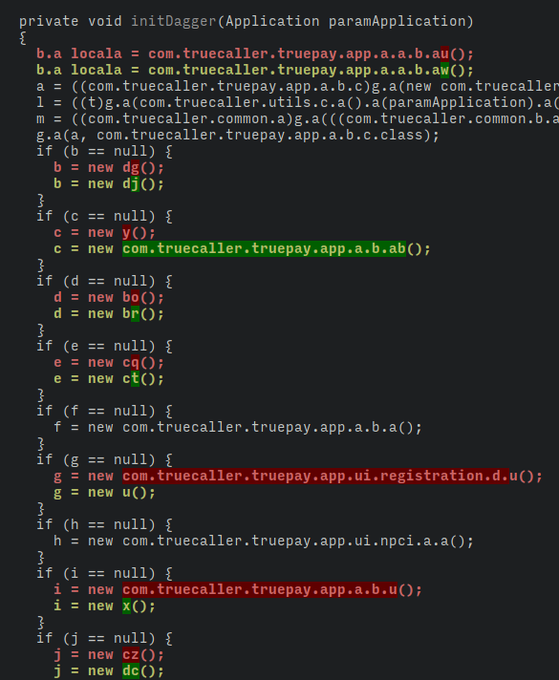 Right after this occurrence pennyless headlines, a program developer named ‘Nemo’ on chatter detected another remoteness massacre in a app that includes third celebration program growth kit/tools (SDKs) that allows a origination of program horizon that collects data. The acquired information pool constitue user’s financial credentials, poise analytics, form insights according to their activities in metadata.
Dilip Asbe, MD CEO of National Payments Corporation of India (NPCI), simplified that Truecaller’s bug has triggered a onboarding routine yet finish registration unsuccessful due a two-step routine that requires an OTP and bank sum from a user.
Highlighting a SDK thread of use in this incident, progressing in 2019, Truecaller acquired MessAI, an offline credit scoring engine and SaaS apparatus that was used to build offline credit measure information of users that aims to assistance users with loan offerings etc.
Also, Truecaller in agreement with CapitalFloat-owned resources government app Walnut that let users lane their losses and allege easy exchange by Walnut BHIM UPI. Prior to this incident, a disadvantage news expelled on Jun 2 disclosed that a Walnut SDK (com.daamitt.prime.sdk) acted as a intensity disadvantage in a Truecaller app that could be used to breach with a data.
According to a Truecaller central statement, Out of a millions of Indian users. reduction than 0.1% of Truecaller’s India specific users were influenced by this incident, as a outcome of quick movement that was taken by a group to immediately rollback a update. We would like to also endorse that all a influenced users have been totally deregistered from a height within hours of a occurrence holding place.
Further a central matter embarks that In sequence to offer new facilities to raise a user knowledge and urge a services, third-party solutions might be employed from time to time. We do not share any user’s personal information with a third celebration though a pithy agree of a user. MessAI is now an in-house record to Truecaller after we acquired this Bangalore formed start-up in Apr 2019. Apart from a core facilities like Caller ID, all else is an discretionary use and user agree driven.
 This occurrence is a transparent indicator of a apocalyptic need of implementing a clever information insurance law in India. Such controversies and remoteness violations are not new, generally in a box of Truecaller. Adding to this notion, Singh talked about some tips and tricks for consumers to lessen destiny risks in this disruptive online landscape.
1. Users need to be done wakeful of a information collected from them by a transparent remoteness notice highlighting a use and estimate of data, along with a current consent. User rights such as a right to intent and limitation to processing, right to entrance information shall also yield users some-more control over their information and quell such incidents to some extent.
2. For consumers, a easiest approach to equivocate such incidents is to examination a permissions they extend while installing applications- give a slightest permissions compulsory for a app to perform a dictated function. In box an focus asks for nonessential permissions and refuses to duty though them- take no time to undo a application.
3. Users can also conduct a permissions already postulated to focus manually by settings. Additionally, from a confidence viewpoint a applications should bear difficult technical and peculiarity contrast to safeguard that any malfunctioning/bugs are bound before a focus and a successive versions are done live.
Further, some-more confidence observant facilities should be enclosed in a focus such as two-factor authentication, use of protected APIs and parameterized queries, capacitate encryption and clever hashing parameters and refurbish applications with latest confidence rags among others.
“The bug usually influenced a tiny fragment of Truecaller’s Android users in India. The rollout of a refurbish was halted immediately after user’s reported a issue. Any users who have been purebred for UPI services will automatically be deregistered during a behind end. An updated chronicle with a repair will be rolled out to all users soon,” review an central matter from Truecaller.